Known washwater
Document detergents, equipment soils, oils, suspended solids and potential contaminants before selecting the treatment package.
 MODULAR INFRASTRUCTURE / WATER RECOVERY
A proposed mobile washwater-recycling plant for fleet wash operations and compatible industrial cleanup streams.
Explore water balance →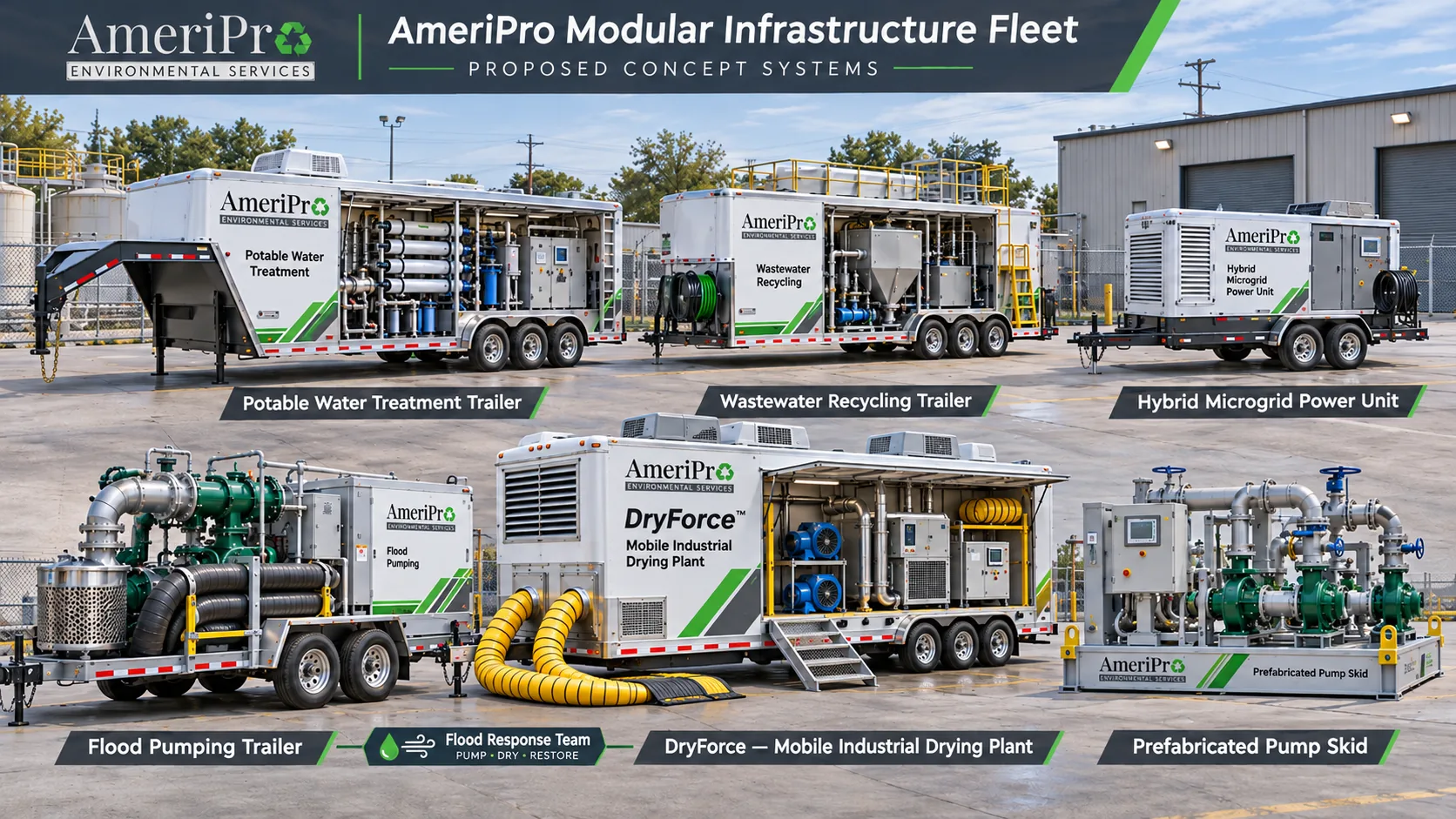
The initial basis is captured vehicle / equipment washwater after source review. Raw sewage, concentrated grease-trap waste and unknown chemical mixtures require separate process designs.
Document detergents, equipment soils, oils, suspended solids and potential contaminants before selecting the treatment package.
Establish product criteria and a monitoring / sampling plan for the particular nonpotable wash stage. Clear appearance alone does not qualify water.
Collect oily solids, flotation sludge, membrane waste and off-spec product for approved handling. No storm-drain discharge is assumed.
Select a stage to inspect its role and limits. Chemical conditioning, polishing and disinfection depend on feed testing and the intended end use.
UF is not a blanket dissolved-contaminant removal claim. Salts, surfactants, dissolved organics and other feed-specific constituents can limit reuse even when suspended solids are reduced.
This train is not an MBR: no biological reactor, sewage-treatment performance or nutrient-removal capability is included. Source-specific alternatives require a separate design basis.
Recovery is an input assumption, not a treatment prediction. The planner checks a proposed operating period against tank limits; it does not approve water quality or disposal.
Average feed = nominal GPM × availability / 100. Scheduled feed gallons = average feed × 60 × scheduled hours. Product = feed × net recovery fraction. Liquid residuals = feed − product. Internal recycle is excluded from the net feed / product boundary; chemical makeup, rainfall and evaporation are not modeled.
Equalization changes at collection inflow minus average feed. Product hold fills at average product rate with release inhibited. In the assumed-release scenario, uniform demand offsets product flow; if demand exceeds production, unmet demand is flagged rather than supplied from an empty tank. Residual storage receives the net liquid waste rate. Tanks are not emptied mid-period.
First intervention is the earliest positive or immediate equalization-full, equalization-empty, product-full or residual-full event. The displayed operating window is the smaller of this event time and scheduled hours. Treatment can require throttling or rescheduling after an intervention; full-schedule outputs must not be read as achieved production. The model uses averaged rates and does not capture batch backwash spikes, hourly inflow surges, solids mass or quality failures.
28 ft nominal body × 8 ft 6 in external width. Axle and hitch configuration, service clearances and road dimensions remain supplier selections.
Proposed transport mass: 12,500 lb. Additional 250 gal process holdup adds 2,085 lb at 8.34 lb/gal, giving 14,585 lb on-site mass against a 16,000 lb design ceiling. At this weight, plan for Class A CDL drivers behind a typical 1-ton pickup.
Source acceptance, equipment tags, product hold, mass / power budgets and validation steps.
Read concept design →$247,000 base allowance plus 20% contingency: $296,400 illustrative capital, including initial tank and capture-kit allowances.
Read costs & exclusions →17.8 kW connected-load study, with voltage, phase, pump starting and power compatibility still unresolved.
Review HybridForce-60 →Primary background: EPA WaterSense vehicle-wash guidance, EPA washwater management BMP and EPA fit-for-purpose reuse overview. These do not certify the proposed treatment train or authorize a particular reuse / discharge.