AmeriPro Environmental ServicesFUTURE CONCEPTS / GREASE RESOURCE RECOVERY
SMARTTRAP + GREX-1000 / CONCEPT REV C

Collect grease.
Recover value.

A proposed restaurant grease-management system paired with a permanent, building-based recovery facility. Separate oil-rich material from water and solids, then qualify a useful feedstock.

Proposed concept — not yet built · No fuel-grade or throughput certification
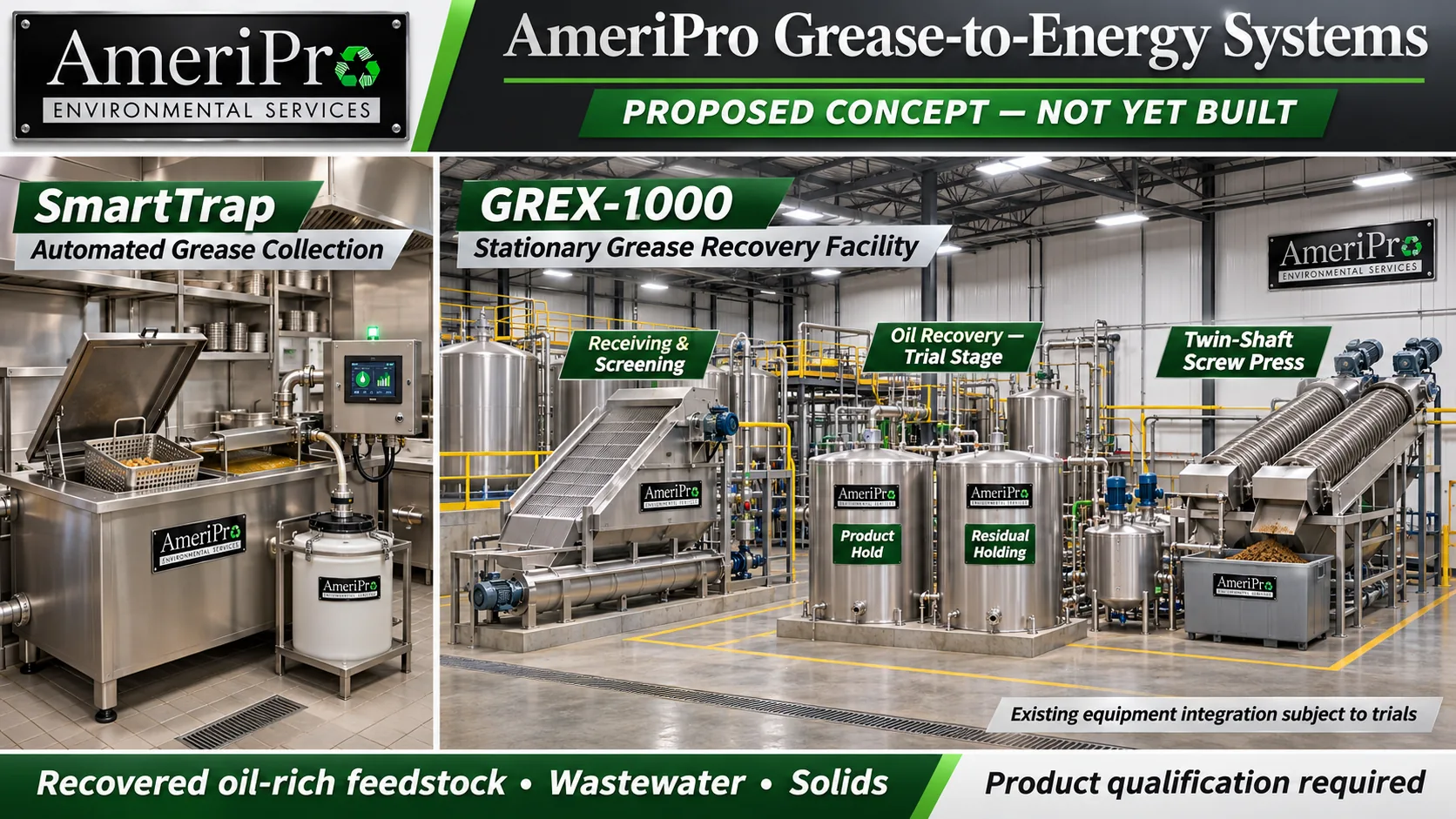
Engineering concept illustration of SmartTrap grease interceptor and GREX-1000 grease recovery plant
SmartTrap and the GREX-1000 stationary facility, with screen separation and twin-shaft screw-press integration.
TWO PRODUCTS / ONE RESOURCE CHAIN

Separate collection from processing.

Keep SmartTrap skimmed material, bulk trap pumpings and used cooking oil identified as distinct streams. Their compositions and recovery economics can differ substantially.

SMARTTRAP / RESTAURANT DEVICE

Capture at the source.

Compact interceptor candidate with a removable solids basket, mechanized grease skimming, sealed recovery container and local monitoring.

  • Grease-layer and liquid-level monitoring concepts
  • Collector-full detection and skimmer inhibit
  • Local service alerts and optional remote records
  • Hydraulic sizing and approval specific to the kitchen

Automatic skimming does not remove the need for cleaning, inspection or required interceptor service. No universal plumbing size or accepted discharge quality is assigned.

GREX-1000 / STATIONARY PROCESS FACILITY

Recover an oil-rich fraction.

Receiving / sampling, screening, tested thermal conditioning, mechanical separation and polishing with separate product and residuals storage.

  • Feed acceptance and batch traceability
  • Temperature-controlled conditioning, limits to define
  • Existing separator and screw press evaluated through trials
  • Product hold pending lab and buyer qualification

GREX-1000 is a working name. No 1,000 GPH, GPD or gallon batch capacity is established. The calculator uses a user-entered wet-feed mass.

01 / RECEIVE & CHARACTERIZEIdentify feed and manage acceptance
02 / CONDITION & SEPARATERecover lipids; contain water and solids
03 / HOLD & QUALIFYBuyer specification before shipment
PERMANENT FACILITY

Build around the process.

AmeriPro has a large building available. GREX can occupy dedicated processing areas with separate tanks and utilities; trailer dimensions and a single skid footprint are no longer design constraints.

EXISTING SEPARATOR

Evaluate before buying

AmeriPro's custom inclined-screen / screw separator is documented in the equipment guide as a solid-liquid machine. Evaluate it for front-end solids removal. Screen slot size, flow capacity and continuous-duty suitability remain open; it is not a demonstrated oil / water separator.

EXISTING SCREW PRESS

Candidate solids branch

AmeriPro's custom PJDL-302 uses two multi-disc screws and polymer conditioning for F.O.G. sludge. The guide records 70–140 kg dry solids/hour, 2.05 kW press-only power and 1,350 kg weight. These ratings do not establish oil yield or whole-facility capacity. Trial a suitable sludge branch and measure oil in cake and filtrate.

BUILDING & UTILITIES

Plan room to operate

Survey truck access, receiving and quarantine, processing, product hold, residual storage, maintenance clearance, floor loading, drainage containment, ventilation, electrical supply and heating utilities before assigning capacities.

Provisional process routing

Receiving → existing screen separator → screened-liquid equalization → additional oil-recovery stage to select through trials → product polishing / hold. Evaluate polymer conditioning and the PJDL-302 on a residual sludge branch. Measure screenings, cake, filtrate and aqueous residual separately; any recycle needs a tested balance.

The custom equipment guide and source drawings / open questions now form the equipment basis. Resolve documented feed-interlock, float and circuit questions during integration. Next inputs are maker F.O.G. trial results, measured stream compositions, building dimensions and daily deliveries.

INTERACTIVE / ASSUMED MASS BALANCE

Test the recovery case.

A simple batch balance for testing recovery and cost assumptions. It omits polymer, separate press filtrate, recycle and oil losses to cake; replace it with measured multi-stream data from equipment trials.

Wet feed and partition assumptions
Batch economics

No fuel conversion, taxes, capital recovery, fixed overhead, storage or rejected-product disposal costs are included. Product hold can create additional storage / disposal costs.

PARTITION & CONTRIBUTION STUDY
Oil-rich product / contained lipids—
Aqueous residual / wet cake—
Batch mass closure—
Modeled sales revenue—
Contribution before fixed costs & capital—

Partition equations and limitations

Feed lipids = wet feed × lipid fraction. Feed dry solids = wet feed × solids fraction; the remaining feed mass is water. Recovered lipids = feed lipids × recovery fraction. Oil-rich product mass = recovered lipids / (1 − product water fraction − product solids fraction).

Subtract product carryover from available water and dry solids. Remaining dry solids enter the modeled wet cake at its assumed dry-solids fraction, with cake liquid treated as water. The remaining water and all unrecovered lipids enter the aqueous residual. No evaporation, chemical additions or separate lipid loss to cake are modeled.

The planner rejects allocations requiring more water or solids than the feed contains. Mass closure is bookkeeping, not a predicted separation result. Aqueous residual can still contain substantial oil and other pollutants; it is not automatically suitable for Reclaim-25 or discharge.

PRODUCT DEVELOPMENT GATES

Feedstock first. Fuel grade later.

Recovered grease is not automatically No. 4 fuel oil, marine fuel, biodiesel or generator fuel. Heating / separation / filtration do not establish any of those grades.

CHARACTERIZE

Know the recovered fraction

Define sampling and buyer-required tests for moisture, sediment / insolubles, acidity / FFA, composition and other source-specific contaminants.

QUALIFY

Identify the actual buyer

Confirm a written feedstock specification and permitted receiving use. Further refining or conversion may belong at a specialist downstream facility.

CONTAIN

Resolve every residual

Characterize aqueous waste and solids, then secure compatible storage and authorized receiving arrangements. Reclaim-25 acceptance requires its own review.

Next engineering review

Obtain representative SmartTrap skimmings and trap-pumping samples, separation trials, a buyer specification and residual receiving costs before freezing equipment.

Read concept design →

Technical background: USDA research on brown-grease lipids, ASTM fuel-oil specification overview and EPA food-service FOG pretreatment overview.